WEEK 1 13/07/2011
Today I started at F & B and when we walked in we was up for a surprise, we had a conference they told us just to help by taking away the empty plates because they where busy eating breakfast. The people of the conference was from Namaqau wine, the one lady asked me for a dompedro as you know it was my first day at F&B so I did not know how to make a dompedro so luckily the staff showed me so I made and served it. That day we just worked on the conference.
The next day we started work at 07:30, we had our vibe meeting the vibe meeting happens every morning then they tell you what your duties are for that day. After that we start cleaning and preparing for the day mopping the veranda and cleaning the waiter station. They called us and showed us how to make filter coffee, cafe late, cuppa-chino, express o and milkshakes. I make the best milkshakes in the house... They also showed us how to work with the computer how to put on orders etc. Then we waiter the rest of the day, the one guest told me I must not be a waiter I must be a manager because one of our waiters messed up his order and I fixed it.
Today is Friday and I am going home for the weekend so i am just working till 13h00. When I wanted to start mopping this morning our manager told me before even you think of poring water into the bucket your caution boards must be up, because if you mop and the floor is wet then it is slippery so some one can slip and fall and sue us for many money and your manager can go to jail.
Tuesday, August 23, 2011


F & B(food and beverage) course started.
It's my time to start at F&B and I am really exited because this course helps me to do what I want to do one day. No I don't want to be a waiter or a restaurant manager, I want to work on a big 5 game lodge and be a jack of all trades. Yes I love doing game-drives and fixing fences and taking out bulrush out of a dam with mud up to my face!! But the reality is you have to be able to do every thing on that lodge, you have to be able to do a booking in reception, you have to know how to prepare a conference for 100 people with 6 x meals in one day, you have to know how to make a nice meal for your guests 100 kilometers in the bush and how to communicate with them. You have to know how to clean the chalets and how to make up the bed. You have to know when to make a joke and when to be serious. This is Africa and people from overseas have big expectations, and some will come and it will be the first time in Africa and it is up to you to give them the time of their life's. And in the end of the day it is that guest paying your salary!!!
So that is why I do this mix course and not only one course.....
So that is why I do this mix course and not only one course.....
Tuesday, June 28, 2011
RESOURSE GUARDIANSHIP (BULLRUSH)
BULLRUSH
NAME
Typha is a genus of about eleven species of monocotyledonous flowering plants in the family Typhaceae. The genus has a largely Northern Hemisphere distribution, but is essentially cosmopolitan, being found in a variety of wetland habitats. These plants are known in British English as bulrush, bullrush, or reedmace in American English as cattail, punks, or corndog grass, in Australia as cumbungi or bulrush, and in New Zealand as raupo. Typha should not be confused with other plantsTypha is a genus of about eleven species of monocotyledonous flowering plants in the family Typhaceae.
DESCRIPTION
Typha leaves are alternate and mostly basal to a simple, joint less stem that eventually bears the flowering spikes. The rhizomes spread horizontally beneath the surface of muddy ground to start new upright growth, and the spread of Typha is an important part of the process of open water bodies being converted to vegetated marshland and eventually dry land.
Typha plants are monoecious and bear unisexual, wind-pollinated flowers, developing in dense spikes. The numerous male flowers form a narrow spike at the top of the vertical stem. Each male (staminate) flower is reduced to a pair of stamens and hairs, and withers once the pollen is shed. The very large numbers of tiny female flowers form a dense, sausage-shaped spike on the stem below the male spike — in larger species this can be up to 30 centimetres (12 in) long and 1 to 4 centimetres (0.39 to 1.6 in) thick. Seeds are minute, 0.2 millimetres (0.0079 in) long, and attached to a fine hair. When ripe the heads disintegrate into dense cottony fluff, from which the seeds disperse by wind. Typha is often among the first wetland plants to colonize areas of newly exposed wet mud; it also spreads by rhizomes, forming dense stands often to the exclusion of other plants.SPECIES
The most widespread species is Typha latifolia, extending across the entire temperate northern hemisphere. T. angustifolia is nearly as widespread, but does not extend so far north; some believe it is introduced and invasive in North America. T. domingensis is a more southerly American and Australian species, extending from the U.S. to South America. T. orientalis is widespread in eastern & northern Australia, temperate & tropical Asia, New Zealand. T. laxmannii, T. minima, and T. shuttleworthii are largely restricted to Asia and parts of southern Europe. Typha latifolia has also been recently introduced into fresh water creeks and lakes in Australia where the water is shallow and contains levels of dirty, turbid water. It affects the flow of the water and also filters the water and catches floating or submerged items, possibly damming the water flow.
Typha plants grow along lake margins and in marshes, often in dense colonies, and are sometimes considered a weed in managed wetlands. The plant's root systems help prevent erosion, and the plants themselves are often home to many insects, birds and amphibians.EDBILE USES
Typha has a wide variety of parts that are edible to humans. The rhizomes, underground lateral stems, are a pleasant nutritious and energy-rich food source that when processed into flour contains 266 kcal per 100 g. They are generally harvested from late autumn to early spring. These are starchy, but also fibrous, so the starch must be scraped or sucked from the tough fibers. The bases of the leaves can be eaten raw or cooked, in late spring when they are young and tender.IIn early summer the sheath can be removed from the developing green flower spike which can than be boiled and eaten like corn on the cob. In mid-summer, once the male flowers are mature, the pollen can be collected and used as a flour supplement or thickener. Typha has also recently been suggested as a source of oil. However, the plant's airborne seeds have also been known to create skin irritation and can trigger asthma.
OTHER USES
The disintegrating heads are used by some birds to line their nests. The downy material was also used by some Native American tribes as tinder for starting fires.Some Native American tribes also used Typha down to line moccasins, and for bedding, diapers, baby powder, and papoose boards. One Native American word for Typha meant "fruit for papoose's bed". Today some people still use Typha down to stuff clothing items and pillows When using Typha for pillow stuffing, dense batting material is used, as the fluff may cause a skin reaction similar to urticaria.
Scientific classification Kingdom: Plantae (unranked): Angiosperms (unranked): Monocots (unranked): Commelinids Order: Poales Family: Typhaceae Genus:
RESOURSE GUARDIANSHIP (FIREBREAKS)
Firebreaks
Firebreaks is very important to have especially if you have a high fire zone… Firebreaks is when you cut grass and not only grass but trees etc next to the roads, next to the fence for the fire not to jump over into your farm or onto your land.
 A firebreak (also called a fire road, fire line or fuel break) is a gap in vegetation or other combustible material that acts as a barrier to slow or stop the progress of a bushfire or wildfire. A firebreak may occur naturally where there is a lack of vegetation or "fuel", such as a river, lake or canyon. Firebreaks may also be man-made, and many of these also serve as roads, such as a logging road, four-wheel drive trail, secondary road, or a highway.
The big problem with firebreaks is if they cut some of the trees in that area or in the line that they want to cut is endangered and if you cut that tree you can get a big fine or they can close your farm or resort. On the resort I am now we’ve got the violet tree that is part of the endangered list. a Good way to show your manager that you’ve got endangered trees on the farm is like this
 You should also get a photo of the trunk with something in it that is man made something like this
 It’s also important to show your manager or give him as much proof as possible.
And very, very important always mark the trees if they are doing fire checks!!!
Johan Wessels
RESOURSE GUARDIANSHIP (HIV AIDS)
INTRODUCTION
The virus responsible for the condition known as AIDS (Acquired Immunodeficiency Syndrome), is named HIV (Human Immunodeficiency Virus). AIDS is the condition whereby the body's specific defense system against all infectious agents no longer functions properly. There is a focused loss over time of immune cell function which allows intrusion by several different infectious agents, the result of which is loss of the ability of the body to fight infection and the subsequent acquisition of diseases such as pneumonia. We will examine the virus itself, the immune system, the specific effects of HIV on the immune system, the research efforts presently being made to investigate this disease, and finally, how one can try to prevent acquiring HIV…
HIGH PROVINCE RATES
In 2008, more than half (55%) of all South Africans infected with HIV reside in the KwaZulu-Natal and Gauteng provinces.
Between 2005 and 2008, the total number of people infected with HIV/AIDS have increased in all of South Africa's provinces except KwaZulu-Natal and Gauteng. Nevertheless, KwaZulu-Natal still has the highest infection rate at 15.5%. In the province with the lowest infection rate, the Western Cape, the total number of people with HIV/AIDS doubled between 2005 and 2008.
Condom use has increased twofold in all provinces between 2002 and 2008. The two provinces where condoms were least used in 2002 were also the provinces where condoms are least used in 2008, namely the Northern Cape and the Western Cape.
HIV/AIDS prevalence among sexually active South Africans by province are:
- KwaZulu-Natal: 25.8%
- Mpumalanga: 23.1%
- Free State: 18.5%
- North West: 17.7%
- Gauteng: 15.2%
- Eastern Cape: 15.2%
- Limpopo: 13.7%
- Northern Cape: 9.2%
- Western Cape: 5.3%
TO AVOID GETTING HIV
HIV is a virus that infects people by getting inside their blood cells. To avoid getting HIV, you must prevent the blood, semen, vaginal fluids, or breast milk of someone who is infected from entering your body through your mouth, vagina, anus, tip of your penis, or breaks in your skin…By having sex the best way is to prevent HIV is to know your partner and to go together for HIV tests. And always be safe always, always use a condom!!!!! !!
RESOURSE GUARDIANSHIP (Red billed Quelea)

Some info on this magnificent bird
The Red-billed Quelea is the world's most abundant wild bird species, with an estimated adult breeding population of 1.5b billion. Some estimates of the overall population have been as large as 10 billion. It is a small passerine bird of the weaver family Ploceidae, native to sub-Saharan Africa.
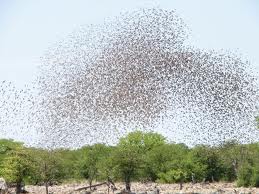
Red-billed Quelea grow to 11-13cm. During breeding the male is distinguished by its more colorful plumage and red billed. Breeding plumage in male queleas is unusually variable, comprising a facial mask which ranges back to white in color, and breast and crown plumage which varies from yellowish to bright red. for the rest of the year male plumage resembles that of the female, which is cryptic beige coloration. The female's bill is yellow during breeding and red during the non-breeding season.
Food

The food of the Red-billed Quelea consists of annual grasses, seeds and grain. As soon as the sun comes up, they come together in their huge flocks and co-operate in finding a suitable feeding place. After a successful search, they settle rapidly and can cause serious damage to crops. In the middle part of the day they rest in shady areas near water and preen. Birds seem to prefer drinking at least twice a day. In the evening they once again fly in search of food.
Reproduction
Breeding is localized and erratic but often colonies include tens of thousands to millions of pairs. the breeding season begins with the seasonal rains, which come at different times in different parts of their range - starting at the north -western edge around the beginning of November. The breeding males first weave half-complete ovoid nest from grass and straw. After the female has examined the construction and the mating has occurred, both partners complete the weaving of the nest. The female lays two to four light blue eggs, and incubates them for twelve days. After the chicks hatch they are nourished for some days with caterpillars and protein-rich insects. After this time parents change to mainly feeding seeds. The young birds fledged and become independent enough to leave their parents after approximately two weeks in the nest. They are sexually mature after just one year, but many birds die before reaching this stage and males may weave nests that go unused if the female dies.
Enemies and population control

They are regarded as pests by farmers because they can eliminate fields in a short period of time. Due to the numbers and localized decimation of cereal crops, control actions have been undertaken. As many as 150-180 million birds have been killed but this appeared to have no effect on the overall quelea population and only temporary relief from crop damage. unfortunately, many non-target birds appeared to have been killed in these control operations and may have had severe population deprevations as a result
Thursday, June 9, 2011
RESOURSE GUARDIANSHIP
WEEK 2 17/05/2011
 This was more of a not to busy week, because it was voting day so everyone was off the Wednesday but I didn't stay home I came to Sondela asking if I could help the people because I knew all the people is going to stay home, so who will do the job?? So I just helped putting up a fence in die Wild life center, after that I went home. The next day I was given the task to count stock in the storeroom that is all the poison, electrical stock(luckily I worked in a hardware shop so I knew what was what). I also counted the farming tools...
This was a quiet week but the little we have done I sure learned a lot. This weekend I am going home I'm just going to sleep and enjoy my mom's cooked vegetables... haha
 This was more of a not to busy week, because it was voting day so everyone was off the Wednesday but I didn't stay home I came to Sondela asking if I could help the people because I knew all the people is going to stay home, so who will do the job?? So I just helped putting up a fence in die Wild life center, after that I went home. The next day I was given the task to count stock in the storeroom that is all the poison, electrical stock(luckily I worked in a hardware shop so I knew what was what). I also counted the farming tools...
This was a quiet week but the little we have done I sure learned a lot. This weekend I am going home I'm just going to sleep and enjoy my mom's cooked vegetables... haha
Subscribe to:
Posts (Atom)